Radio That Will Come on Again After Power Interruption
Wildfire
When Your Ability's Out, Cyberspace'south Off and There'southward No Cell Service, Radio Still Works
Failed to salve commodity
Please attempt again
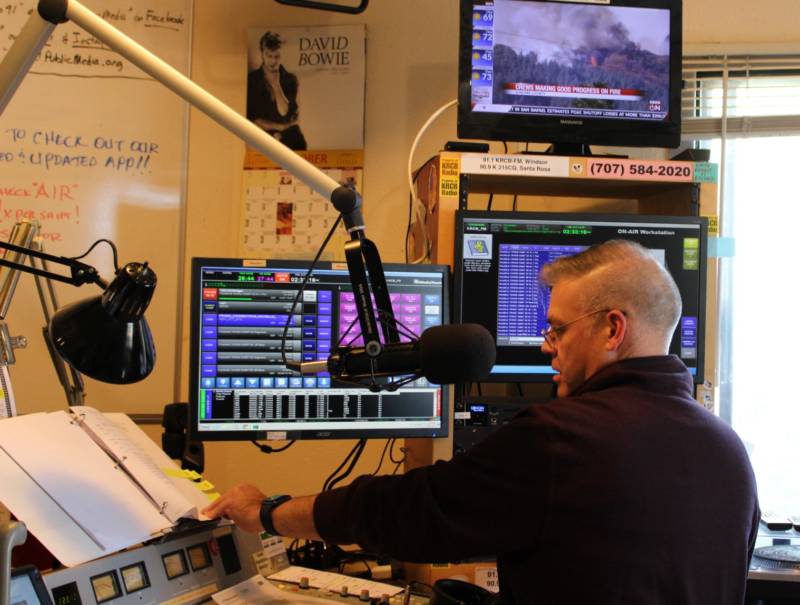
Journalist/operator Marker Prell at the helm of KRCB-FM Radio 91 during Kincade Burn down coverage. (Danielle Venton/KQED)
The Kincade Burn down is 100 percent contained. Emergency officials are earning praise for the manner they communicated evacuation orders and health advisories. But, along with mobile phone and social media alerts, the humble 100-year-old engineering science of radio proved its value again.
Information technology'due south reliable when everything else — the electrical filigree, internet, prison cell service — is down. Radio tin immediately relay information if information technology's got backup ability. It doesn't require anyone to edit text or add visuals. And, during times of crisis, information technology calms anxious listeners eager to hear a familiar vocalisation.
Tami Scharff of Santa Rosa says she never thought her town would face up another crunch only two years after the wildfires of 2017.
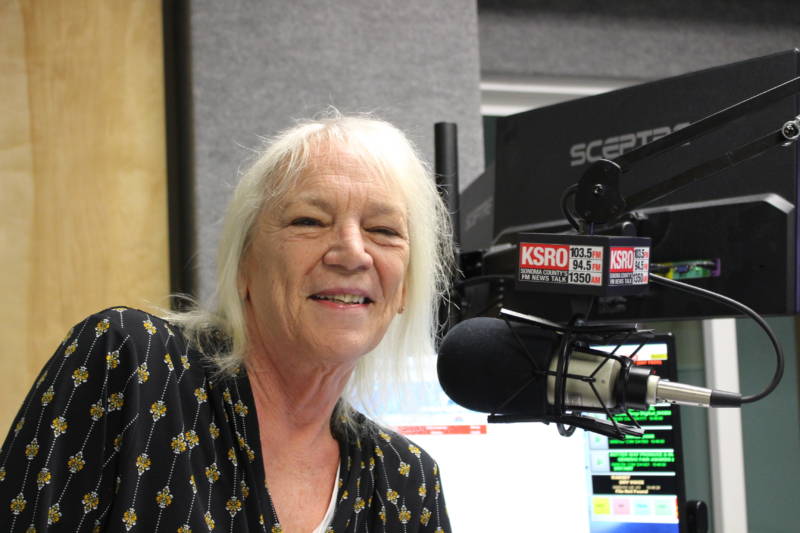
"Unfortunately," she says, "it was, OK, here we go once again. And I really just right away go to KSRO."
KSRO is a News-Talk radio station in Sonoma County. Ii years agone and again this Fall, it offered rolling, 24/7 wildfire coverage, taking listener calls and amplifying officials and emergency responders on air.
"In 2017 it was such a lifeline," Scharff says. "We were in an evacuation warning from the outset day on."
For days she carried in her car everything she planned to take in case that warning became an society.
"And I remember when the Annadel Fire was going on right near our habitation, I kept saying to my husband, 'If I encounter flames, we're going.' " Scharff says.
"All of a sudden, a huge [fume] plume came upwards and I say, 'We've got to become, nosotros've got to go!' Right then, I hear on the radio, which I had on the whole time, saying 'Bennett Valley people, it'southward a back burn down!'"
Firefighters had set it on purpose to stop budgeted flames. At that place was no need to evacuate. Scharff says she and her husband sighed with relief.
"Having the radio on, telling united states of america what was going on minute-by-minute. Information technology was and then, and then vital when you're going through something like that."
A Personal Connection
Steve Garner normally hosts a gardening and a culinary show on KSRO. Only when he needs to, he steps easily into the office of news anchor.
"You have to be a rock," he says. "You have to reassure people that it's going to be OK. You accept to make sure yous don't jump the gun and give out inaccurate information."

Garner points to social media as an irritating source of incomplete, inaccurate or speculative information about what the first responders were doing.
"While they were out putting out literal fires, we were putting out fires considering of misinformation, squelching the rumor line."
At that place'south some other reason people melody in, he says.
"Radio is most a personal connexion. Hearing people'due south voices rather than just reading their words.
"When I was on air I tried to balance the difficult news, the difficult interviews and something I saw in the community that was heartwarming, for instance when someone that told me they had only been reunited with their pet," Garner says. "These are the stories that humanize us and bring usa together and and momentarily tin distract u.s. enough to recall that this, too, will pass."
Lessons from 2017 Pay Off in 2019
Redwood Empire Stereocasters owns 5 broadcast stations with formats from country to jazz. During 2017, and over again this yr, the stations merged their streams and provided continuous news coverage.
"We didn't take a plan in 2017," says general managing director Frank Kulbertis. "Information technology was haphazard and fly by the seat of our pants."
This time, he says, his staff prepared for the task. He keeps on his desk a binder with emergency contacts for emergency and locally elected officials.
"When this broke out this time, information technology was kind of easy for me hop on the telephone and line these people upward to be on air and tell united states of america what was going on," Kulbertis says.
With an emergency staffing plan in place, everyone took on new task roles. He booked interviews and updated the website.
"Nosotros had on air-personalities that are typically doing music and happy talk and that sort of thing doing serious news reports," the full general manager recalls. "We had people from our sales staff who normally are trying to sell advert, spending fourth dimension on phones and online, contacting public officials, gathering information and getting notes into the studio."
In preparation, the stations also outfitted the studios with two large generators, and installed generators at each of their tower sites. They were never off the air.
Burn down Hits a Transmitter
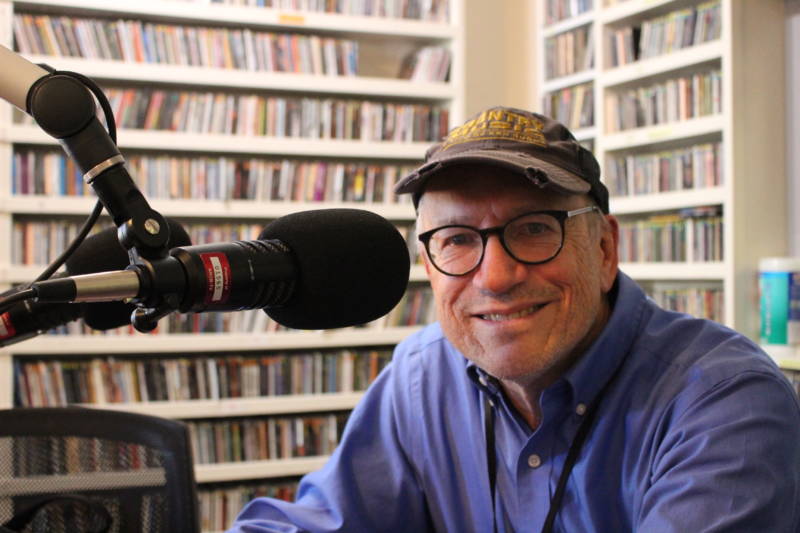
That wasn't the case for all of Sonoma Canton's local stations. NPR member station KRCB 91-FM transmits on two frequencies: 90.nine and 91.one. Afterwards the Kincade Fire exploded on the dark of Oct. 23, program director and operations manager Sean Knight was in his car and couldn't hear his station on its 91.1 frequency.
"It was but off and I thought, 'Well, that'due south dissimilar.'"
A few calls and a little investigating indicated that the transmitter, 1,700 feet above sea level in the Geyser Hills area, had burned. The station had installed the high-definition transmitter in March.
Nature besides took down the station's previous set, Knight says.
"Information technology got knocked down in the rainstorms back in January. So we just got it replaced." Knight adds. "We can't grab a break with that affair."
The transmitter loss reduced the station'south reach over the air. Even so, like its commercial counterparts, KRCB stayed on the air throughout the wildfires.
"We still had 90.9, and all of our social media, and streams and the apps," he says. "So I only said, 'Keep the news flowing, and when there's no news play some music.'"
In the meantime the station contacted NPR in Washington, D.C.. This yr, the network created a program to supply temporary backup transmitters and antennas to stations that become off the air during emergencies.
Knight shows me the new replacement, ready in the station's lawn in Rohnert Park. To the untrained heart it looks like a thick silver paper clip loftier up on a tower.
He proclaims: "We're calling it Inferior."
91.1 FM is back upwardly and running.
Radio Rises Again
Justin Lane lives in Cotati. He and his family unit lost electricity, internet and cell service. They found emergency alerts "basically unusable."
If PG&E shuts off power again for an extended period of time, he'south not counting on using his phone.
"Moving forward, I'k just going to brace for the worst," Lane says. "We've got a battery- operated radio now, which is great equally long equally the radio stations kind of go along doing what they did this final time, keeping us updated constantly."
That'due south one reason the American Red Cross recommends that everyone's emergency kit includes a radio.
After the 2017 N Bay Fires, the Napa Canton Grand Jury convened an investigation into what worked and what didn't work in saving lives in Napa. The written report reads, in role: When the power went out, and the public could no longer receive information from Television, the Net or Nixle, information technology was old technology that saved the day. Residents got in their cars or dug out their battery powered radios to tune in to KVON.
"I actually think that erstwhile school radio has been far also oft overlooked too, because it is a major aqueduct to reach the people who need it to get a mass message in a mass disaster," says Doug Carlson, a one-time reporter and public information officer who advocates for improved communications during wildfire crises.
"It has worked for the last hundred years and we can't ignore it going forward."

On KZST, Mike Adams unremarkably plays three decades of popular hits. When the station and its affiliates switched to fire coverage, he became part reporter, part emergency coordinator.
"We're the ones that are going to requite you the data you demand," he says. "We're the ones that are are gonna be in that location for you when you call."
Adams remembers a call from an elderly couple trying to evacuate their neighborhood and drive to rubber. "They were bankrupt down on the side of the route and they needed help."
Unsure about what to practice, they called the station.
"And you can see me tearing up over this," Adams says"A listener pulled up and helped them. They got taken care of."
At present that the emergency's wound down, KZST, KSRO and other North Bay stations are back to their normal programming.
Every bit they do, the boost in listenership will likely subside. That'southward likewise bad, Kulbertis says, adding, "I wish it didn't take circumstances like these for people to understand the value of radio."
You lot tin can count on it, even though it's non the newest technology.
"I mean, I honestly think we are the Rodney Dangerfield of all media," he sighs. "We get no respect except maybe at times like this and then it's fleeting."
Until...of course...side by side fourth dimension.
KQED's Miranda Leitsinger contributed reporting to this post.
Source: https://www.kqed.org/science/1950762/when-your-powers-out-internets-off-and-theres-no-cell-service-radio-still-works
0 Response to "Radio That Will Come on Again After Power Interruption"
Post a Comment