I Dont Know if Ill Be Coming Home Again Home Again
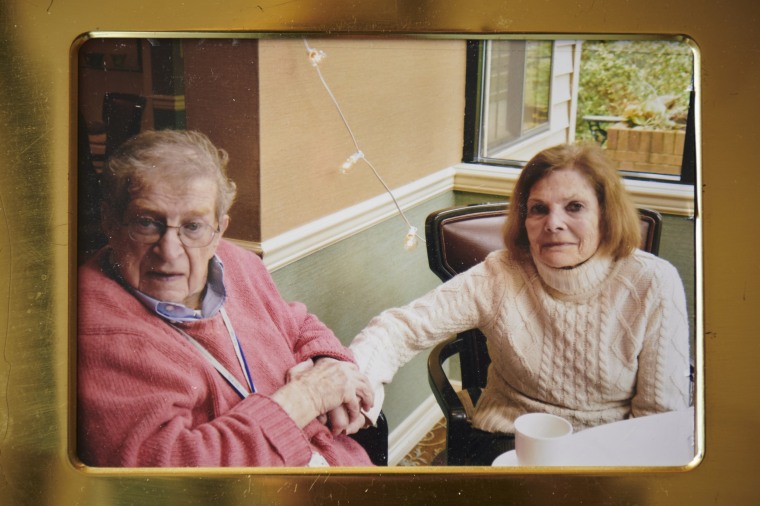
Twice a day, Bonnie Polin, 78, drives a few miles to visit her husband at his nursing home in Portland, Oregon. She sits with him while he eats breakfast and tells him stories that she knows he probably won't remember.
"I vicious in honey with him because he was then damned smart, and now he's in the terminate stages of Parkinson's disease," Polin said of her hubby, Gerald, 83, a retired psychiatrist. "Merely he's nonetheless as handsome equally always."
Polin paused early on ane morning last week when she arrived for a visit and noticed a new sign posted at the entrance. In response to the worsening coronavirus outbreak, officials at the Avamere Crestview of Portland, an adult care facility, like untold numbers of other nursing homes across the country in recent days, had decided to ban visitors.
Polin read the sign twice. Then she darted past it and went looking for her married man. In the nearly 58 years since they got married, the pair had rarely spent a day autonomously. When Polin found him, asleep in his wheelchair, she grabbed his mitt.
She knew she wouldn't take long.
"Sweetie, I'm not going to be able to come see you for a while," she recalled telling him.
She explained that at that place was a serious new virus spreading in Oregon and across the country, and that elderly people were at higher take chances — though she doubts he understood any of that. A minute afterwards, a nursing habitation staff member arrived and told Polin she needed to exit.
She kissed her husband and told him goodbye; he didn't reply.
"I don't know when I'll run across y'all again," she told him, before heading for the exit.
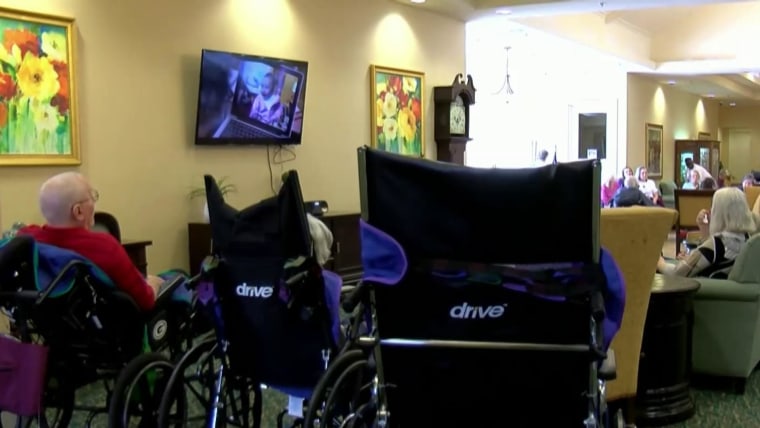
For Polin and thousands of others with relatives in nursing homes, the coronavirus outbreak has ushered in a painful new normal. Later on a nursing habitation outside Seattle became the U.S. epicenter of a deadly outbreak that has killed at least eighteen residents, senior living facilities effectually the nation have begun banning visitors, in the hopes of preventing similar tragedies.
Many nursing homes have been restricting visits from people with flu-like symptoms and those who have recently traveled abroad. But in recent days, equally the number of confirmed coronavirus cases in the U.Due south. has grown, many facilities announced that they would begin prohibiting social visits altogether.
"Every bit every day unfolds, information technology becomes clearer that the skilled nursing sector and the assisted living sector face one of the most significant challenges, if not the well-nigh significant challenge, in our histories," said Mark Parkinson, president and CEO of the nursing domicile merchandise group American Health Care Association, which Tuesday announced new national guidance recommending that nursing homes prohibit visits from anyone other than wellness care providers and other essential workers. "The evidence has become overwhelming that the mortality rate to COVID-nineteen for people that live in our buildings is shocking."
Although many patients have reported only moderate symptoms, experts say people over the age of 70 are at serious risk of respiratory failure or expiry. Parkinson said experts were telling him that the death rate for people over the age of 80 might well exceed xv per centum, though government officials say information technology won't exist possible to calculate a true mortality rate until far more people are tested.
On Monday, New York Gov. Andrew Cuomo announced that state officials had barred visitors from senior living facilities in New Rochelle, a New York City suburb at the center of an emerging outbreak in the region. After that evening, the Centers for Disease Control and Prevention issued national guidelines for nursing homes, including a recommendation to limit or stop social visits from loved ones.
Public wellness officials say these drastic measures are needed to slow the spread of the coronavirus among those near vulnerable to it.
Equally the outbreak worsened at the Life Intendance Center in the suburbs of Seattle last week, news reports revealed the tragic consequences that can follow when a nursing home is put on lockdown — a grim foreshadowing of what experts worry could be repeated across the country in the coming weeks.
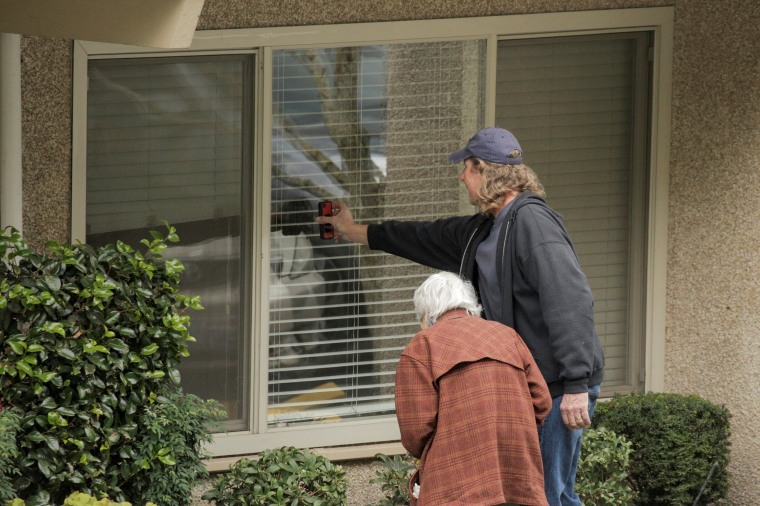
Some of those cutting off from their elderly loved ones at Life Care said they were struggling to learn bones details virtually what was happening in the facility. Others said they feared they would never see their parents or grandparents once again, given their poor wellness. Photos of a grayness-haired woman standing at a window, trying to talk to her quarantined married man on the other side of the glass, made national headlines.
Practice you lot accept a story to share almost your experience with nursing homes during the coronavirus outbreak? Contact united states of america
Bryan James, an epidemiologist at the Blitz Alzheimer's Disease Center in Chicago, said nursing homes are probably doing the right affair by restricting access until the outbreak is brought under control. But those decisions come at a price, said James, who studies the fashion people'due south social connections affect their health every bit they age.
"I think that by isolating people and saying that their family unit members tin can't come to encounter them, you tin very well see scenarios where people begin losing a sense of purpose in their lives," James said. "That social connexion is incredibly of import in keeping people going every mean solar day and keeping people healthy."
James said relationships with friends and family assist people stay mentally sharp as they grow older. He worries that prolonged restrictions on nursing habitation visits could be devastating for some residents, especially those already in very poor health. Some, he said, might be forced to spend their terminal moments lone.
"We already have the problem of people dying alone in this country at such high numbers," he said. "And now I worry that nosotros're going to accept fifty-fifty more people dying alone in hospice without their loved ones next to them, even though their families desperately want to be with them."
Full coverage of the coronavirus outbreak
Yvonne Michael, an epidemiologist at Drexel University's Dornsife School of Public Health in Philadelphia, said nursing homes that ban visitors might need to program additional social activities to keep residents from feeling isolated.
Merely that won't aid family unit members on the outside.
"At the finish of the 24-hour interval, it might be harder for the person outside the nursing home than the one inside of information technology," Michael said. "For the family members on the outside, that sense of hopelessness — of not being able to be with their loved one who needs them — could also be devastating."
Source: https://www.nbcnews.com/news/us-news/nursing-home-s-coronavirus-lockdown-keeps-wife-her-husband-58-n1154246
0 Response to "I Dont Know if Ill Be Coming Home Again Home Again"
Post a Comment