William Tyndale Bible 1526 to Read Modern Spelling
| William Tyndale | |
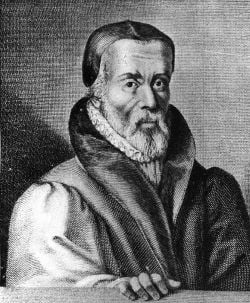 Protestant reformer and Bible translator | |
| Built-in | ca. 1494 Gloucestershire, England |
|---|---|
| Died | September vi, 1536 well-nigh Brussels, Belgium |
William Tyndale (sometimes spelled Tindall or Tyndall) (ca. 1494–September 6, 1536) was a sixteenth century Protestant reformer and scholar who translated the Bible into the Early Modern English language of his solar day. Although a number of partial and consummate English translations had been made from the 7th century onward, Tyndale's was the starting time to take advantage of the new medium of print, which allowed for its wide distribution. In 1535, Tyndale was arrested, jailed in the castle of Vilvoorde exterior Brussels, Belgium for more than a year, tried for heresy and treason and then strangled and burnt at the pale in the castle's courtyard. [1] At the time, the Church believed that if lay people had direct access to the Bible they would misinterpret and misunderstand what they read. Possibly, they would question the education of the Church building and the authorisation of the priests. By keeping the Bible in Latin, which few other than priests and scholars could, read, the role of the priest equally gatekeeper was protected.
Contents
- 1 Early Life
- ii Translating the Bible
- 3 Persecution
- four Tyndale'southward legacy
- 4.1 Tyndale's Long-Term Impact on the English Bible
- 5 Memorials
- six Notes
- seven References
- 8 External links
- 9 Credits
Tyndale also made a significant contribution to English language through many of his phrases that passed into popular apply. His legacy lives on through his connected influence on many subsequent English translations of the Bible. Much of Tyndale's work eventually plant its way into the Male monarch James Version (or Authorized Version) of the Bible, published in 1611, and, though nominally the work of 54 independent scholars, is based primarily on Tyndale's translations.
Early on Life
William Tyndale was born around 1494, probably in i of the villages near Dursley, Gloucestershire. The Tyndales were also known nether the proper name Hychyns (Hitchins), and it was as William Hychyns that he was educated at Magdalen Hall, Oxford (now office of Hertford College), where he was admitted to the Degree of Bachelor of Arts in 1512, the same year he became a subdeacon. He was made Master of Arts in July 1515, three months afterwards he had been ordained into the priesthood. The MA caste allowed him to kickoff studying theology, but the official class did not include the study of scripture. This horrified Tyndale, and he organised individual groups for teaching and discussing the scriptures. He was a gifted linguist (fluent in French, Greek, Hebrew, German, Italian, Latin, Spanish and of course his native English) and afterwards went to Cambridge (mayhap studying under Erasmus, whose 1503 Enchiridion Militis Christiani — "Handbook of the Christian Knight"—he translated into English language), where he is believed to have met Thomas Bilney and John Frith.
Translating the Bible
He became clergyman in the house of Sir John Walsh at Little Sodbury in about 1521, and tutor to his children. His opinions involved him in controversy with his beau clergymen, and around 1522 he was summoned before the Chancellor of the Diocese of Worcester on a accuse of heresy.
Presently afterwards he already adamant to translate the Bible into English: he was convinced that the fashion to God was through His give-and-take and that scripture should be available fifty-fifty to mutual people. Foxe describes an argument with a "learned" but "blasphemous" clergyman, who had asserted to Tyndale that, "We had better exist without God's laws than the Pope'south." In a swelling of emotion, Tyndale fabricated his prophetic response: "I defy the Pope, and all his laws; and if God spares my life, I volition crusade the boy that drives the plow in England to know more of the Scriptures than the Pope himself!"[2] [3]
Tyndale left for London in 1523 to seek permission to translate the Bible into English language and to request other aid from the Church. In particular he hoped for back up from Bishop Cuthbert Tunstall, a well-known classicist whom Erasmus had praised afterwards working with him on a Greek New Attestation, simply the bishop, similar many highly-placed churchmen, was uncomfortable with the idea of the Bible in the vernacular and told Tyndale he had no room for him in the Bishop'southward Palace. Tyndale preached and studied "at his book" in London for some time, relying on the assist of a cloth merchant, Humphrey Monmouth. He then left England under a pseudonym and landed at Hamburg in 1524 with the work he had done so far on his translation of the New Testament, and in the following year completed his translation, with help from Observant friar William Roy.
In 1525, publication of his work by Peter Quentell in Cologne was interrupted by anti-Lutheran influence, and information technology was not until 1526 that a full edition of the New Testament was produced by the printer Peter Schoeffer in Worms, a safe city for church reformers. More than copies were before long existence printed in Antwerp. The volume was smuggled into England and Scotland, and was condemned in Oct 1526 by Tunstall, who issued warnings to booksellers and had copies burned in public.
Persecution
Following the publication of the New Attestation, Primal Wolsey condemned Tyndale every bit a heretic and demanded his arrest.
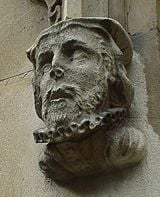
Sculpted Caput Of William Tyndale from St Dunstan-in-the-West Church London
Tyndale went into hiding, possibly for a time in Hamburg, and carried on working. He revised his New Testament and began translating the Old Testament and writing various treatises. In 1530, he wrote The Practyse of Prelates, which seemed to motility him briefly to the Catholic side through its opposition to Henry VIII'due south divorce. This resulted in the king's wrath being directed at him: he asked the emperor Charles V to have Tyndale seized and returned to England.
Eventually, he was betrayed to the regime. He was kidnapped in Antwerp in 1535, betrayed by Henry Phillips, and held in the castle of Vilvoorde virtually Brussels.
He was tried on a charge of heresy in 1536 and condemned to the stake, despite Thomas Cromwell'south intercession on his behalf. Tyndale was strangled and his body burned at the pale on September 6, 1536. His last words reportedly were, "Oh Lord, open up the King of England's eyes."[iv]
Tyndale's legacy
In translating the Bible, Tyndale introduced new words into the English linguistic communication:
- Jehovah (from a transliterated Hebrew structure in the Old Testament; composed from the tetragrammaton YHWH and the vowels of adonai: YaHoWaH)
- Passover (as the name for the Jewish holiday, Pesach or Pesah),
- Atonement (= at + onement), which goes beyond mere "reconciliation" to hateful "to unite" or "to cover," which springs from the Hebrew kippur, the Old Testament version of kippur existence the covering of doorposts with blood, or "Day of Atonement."
- scapegoat (the goat that bears the sins and iniquities of the people in Leviticus Chapter 16)
He also coined such familiar phrases as:
- permit there be light
- the powers that be
- my brother's keeper
- the salt of the earth
- a constabulary unto themselves
- filthy lucre
- information technology came to pass
- gave upwards the ghost
Some of the new words and phrases introduced by Tyndale did not sit well with the hierarchy of the Roman Catholic Church, using words similar 'Overseer' rather than 'Bishop' and 'Elder' rather than 'Priest', and (very controversially), 'congregation' rather than 'Church' and 'love' rather than 'charity'. Tyndale contended (with Erasmus) that the Greek New Testament did non support the traditional Roman Cosmic readings.
Contention from Roman Catholics came from existent or perceived errors in translation. Thomas More than commented that searching for errors in the Tyndale Bible was similar to searching for h2o in the bounding main. Bishop Cuthbert Tunstall of London declared that there were up of 2,000 errors in Tyndale's Bible. Tunstall in 1523 had denied Tyndale the permission required under the Constitutions of Oxford (1409), that were still in force, to translate the Bible into English language, and forced him into exile.
In response to allegations of inaccuracies in his translation in the New Attestation, Tyndale wrote that he never intentionally contradistinct or misrepresented whatever of the Bible in his translation, and would never do then.
While translating, Tyndale controversially followed Erasmus' (1522) Greek edition of the New Testament. In his Preface to his 1534 New Testament ("WT unto the Reader"), he not but goes into some detail about the Greek tenses just besides points out that there is often a Hebrew idiom underlying the Greek. The Tyndale Society adduces much further show to show that his translations were made direct from the original Hebrew and Greek sources he had at his disposal. For example, the Prolegomena in Mombert's William Tyndale's Five Books of Moses show that Tyndale'south Pentateuch is a translation of the Hebrew original.
Of the commencement (1526) edition of Tyndale's New Testament, simply iii copies survive. The just complete copy is function of the Bible Collection of Württembergische Landesbibliothek, Stuttgart. The copy of the British Library is almost complete, lacking simply the title page and list of contents.
Tyndale'southward Long-Term Bear upon on the English Bible
The men who translated the Revised Standard Version in the 1940s noted that Tyndale'southward translation inspired the neat translations to follow, including the Bully Bible of 1539, the Geneva Bible of 1560, the Bishops' Bible of 1568, the Douay-Rheims Bible of 1582–1609, and the King James Version of 1611, of which the RSV translators noted: "It [the KJV] kept felicitous phrases and apt expressions, from whatsoever source, which had stood the test of public usage. Information technology owed most, peculiarly in the New Testament, to Tyndale."
Many of the great English versions since then have fatigued inspiration from Tyndale, such as the Revised Standard Version, the New American Standard Bible, and the English language Standard Version. Even the paraphrases like the Living Bible and the New Living Translation have been inspired by the aforementioned desire to make the Bible understandable to Tyndale's proverbial ploughboy.
Memorials
A bronze statue by Sir Joseph Boehm commemorating the life and work of Tyndale was erected in Victoria Embankment Gardens on the Thames Embankment, London in 1884. It shows the reformer'south right hand on an open Bible, which in plow is resting on an early on printing printing.
There is too a memorial tower, the Tyndale Monument, erected in 1866 and prominent for miles around, on a hill above his birthplace of N Nibley.
The site in Vilvoorde, Belgium (fifteen minutes northward of Brussels by train) where Tyndale was burned is also marked by a memorial. It was erected in 1913 by Friends of the Trinitarian Bible Society of London and the Kingdom of belgium Bible Society.
He is commemorated in the Agenda of Saints of the Evangelical Lutheran Church building in America as a translator and martyr on October 6.
Tyndale University College and Seminary, a Christian university college and seminary in Toronto, is named after William Tyndale.
Notes
- ↑ English Bible History, Greatsite Marketing. Retrieved August xviii, 2007.
- ↑ Lecture by Dom Henry Wansbrough OSB MA (Oxon) STL LSS Retrieved Baronial 18, 2007.
- ↑ Foxe'southward Book of Martyrs, Chap XII Retrieved August 18, 2007.
- ↑ The Expose and Expiry of William Tyndale, Greatsite Marketing. Retrieved Baronial 18, 2007.
References
ISBN links support NWE through referral fees
- Bobrick, Benson. Wide as the waters: the story of the English Bible and the revolution it inspired. New York: Simon & Schuster 2001. ISBN 9780684847474
- Daniell, David. William Tyndale: a biography. New Haven: Yale University Press 1994. ISBN 9780300061321
- Tyndale, William, and David Daniell. Tyndale'southward New Testament. New Haven, Conn: Yale University Press 1989. ISBN 9780300044195
External links
All links retrieved Oct 10, 2020.
- Tyndale House Publishers
- Talk on the Tyndale New Attestation by British Library curator
- Tyndale Society homepage
- Works by William Tyndale. Projection Gutenberg
- Find A Grave Entry
- William Tyndale
- Why William Tyndale Lived and Died
- Canadian Christian education institute named later on William Tyndale
Credits
New Earth Encyclopedia writers and editors rewrote and completed the Wikipedia article in accord with New World Encyclopedia standards. This article abides by terms of the Creative Commons CC-past-sa 3.0 License (CC-by-sa), which may exist used and disseminated with proper attribution. Credit is due under the terms of this license that can reference both the New Globe Encyclopedia contributors and the selfless volunteer contributors of the Wikimedia Foundation. To cite this article click hither for a list of acceptable citing formats.The history of earlier contributions by wikipedians is attainable to researchers here:
- William Tyndale history
The history of this commodity since it was imported to New World Encyclopedia:
- History of "William Tyndale"
Note: Some restrictions may utilise to use of individual images which are separately licensed.
Source: https://www.newworldencyclopedia.org/entry/William_Tyndale
0 Response to "William Tyndale Bible 1526 to Read Modern Spelling"
Post a Comment